



Going beyond tick-boxes: delivering a 2.7x uplift on insights
Wholesum worked with Female Founders Rise, Barclays and Nottingham Business School to analyse a large-scale survey of over 2,200 UK female entrepreneurs — turning open-ended responses into richer, more nuanced insight than standard closed-question surveys allow.
“Standard survey questions would have given us tidy categories, but not the real story. Wholesum's approach let entrepreneurs answer in their own words, and still gave us something rigorous and structured to work with. It's given us a much richer, more honest picture than a tick-box survey ever could. I'd highly recommend working with Wholesum.”
Emmie Faust
CEO and founder of Female Founders Rise.
The challenge
When asked what long-term success means to them, founders gave free-text answers rich with nuance — but also full of overlapping ideas, UK-specific funding terminology, and competing interpretations. Standard quantitative survey questions couldn't capture this complexity, and simply coding open text by hand risked inconsistency and hidden bias, as well as being prohibitively time-consuming across 11 open-ended questions.
What Wholesum did
Applied comparative statistical inference across the full dataset, rather than interpreting each response in isolation
Identified where interpretation depended on UK-specific funding terminology, and resolved it using comparative judgement across responses
Distinguished founders whose answers mapped clearly onto one idea from those whose responses reflected overlapping motivations
Results
Wholesum's analysis pipeline enabled the largest, most in-depth grassroots study of female entrepreneurship ever conducted in the UK:
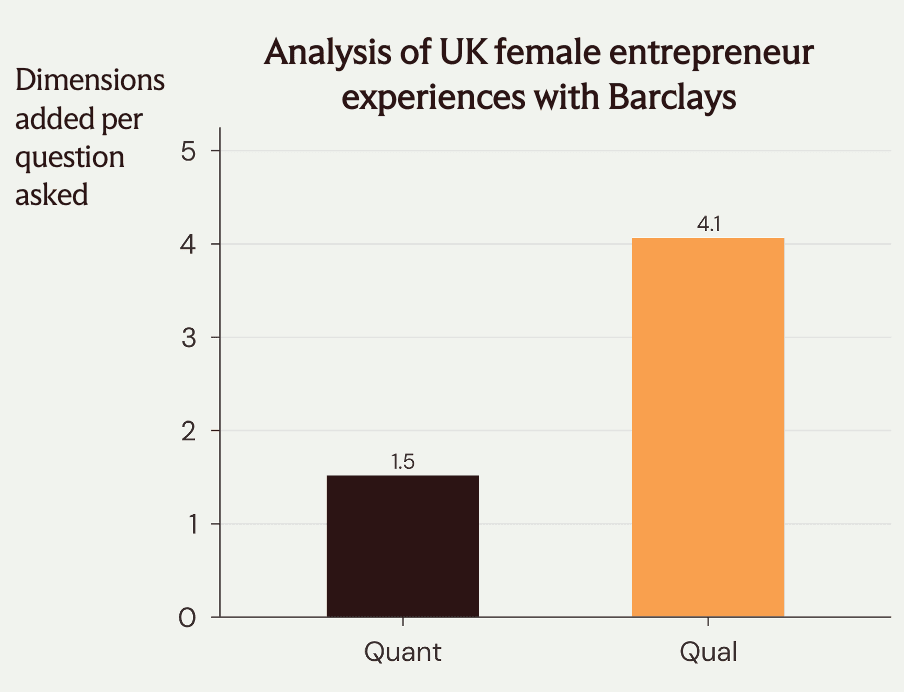
Richer signal from processing nearly 500,000 words
Qualitative responses surfaced far more distinct dimensions per question than closed/quantitative questions, showing how much nuance standard survey scoring alone misses:
Four clear, evidence-based success themes
Financial stability and profitability; business growth and exit; positive social or environmental impact; and work-life balance and flexibility.
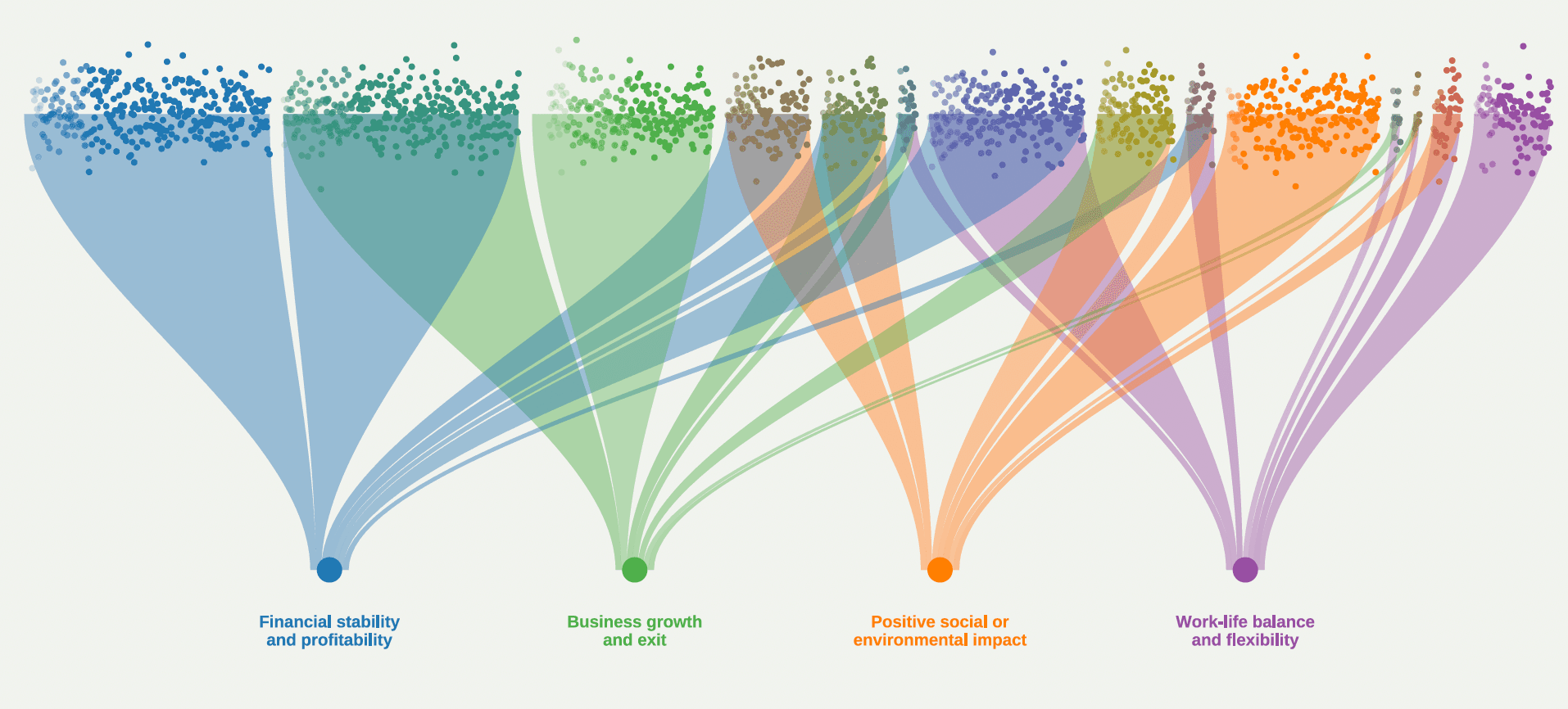
Each dot represents one founder, grouped by the combination of success themes identified in their response. Dot opacity shows the stability of that theme assignment across the analysis, with lower stability mainly reflecting competing interpretations. A nuanced yet stable and defensible view
Of what it means to be a female founder, and how best they can be supported.